BBC News Myanmar: Aung San Suu Kyi - the rose hidden by the military (an interview with Alan Clements)
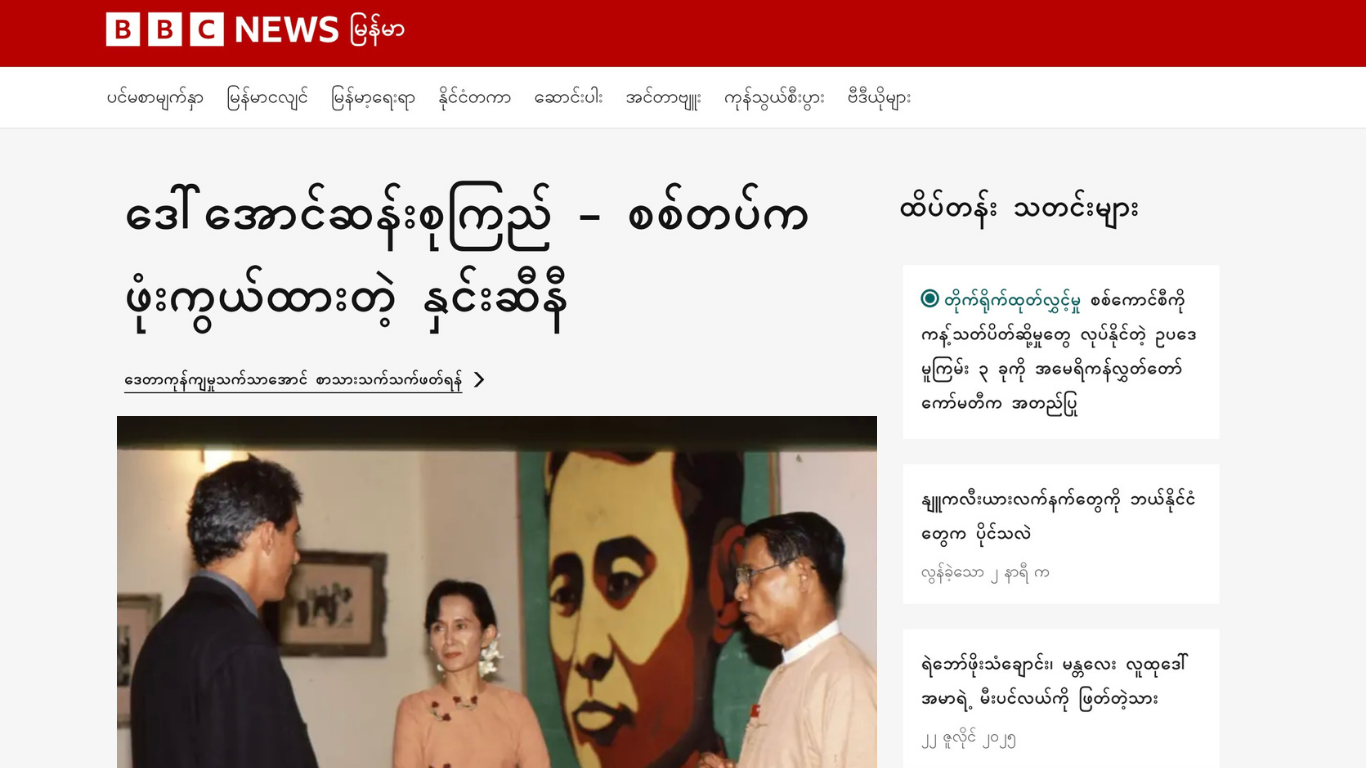
Aung San Suu Kyi - the rose hidden by the military
BBC News Myanmar, July 2025
On July 19, 2025, hopes that Daw Aung San Suu Kyi might be permitted to visit the Martyrs’ Shrine to pay her respects—or that the revered leader, unseen in public for over four years, might appear, even fleetingly, on screen—were extinguished.
Security in Yangon was stringent on the eve of Martyrs’ Day, as the coup leader was present in the city and attended the ceremony in person. Speculation that Daw Aung San Suu Kyi would not be seen publicly proved correct when the morning of Martyrs’ Day arrived without her presence.Courtroom security camera footage, released by The Guardianaround the time of her 80th birthday, captured a haunting image of the leader, masked and somber—a stark reminder of her isolation in her final days.
Recent reports that Daw Aung San Suu Kyi was injured in an earthquake have intensified concerns about her well-being. Observers note that, despite her steadfast pursuit of negotiation and national reconciliation, the military regards her as their primary adversary.Analysts suggest that the treatment of Daw Aung San Suu Kyi under the current military regime is far more severe than during previous juntas, marked by an unprecedented level of brutality.
Daw Aung San Suu Kyi faces lengthy prison sentences on charges she has publicly dismissed as “absurd.” The military has severed her connections to the outside world, dismantled her National League for Democracy (NLD) party, and even attempted to auction her historic residence at 54 University Avenue.
Two divergent perspectives persist regarding her potential role in Myanmar’s political future. Some view her as a valuable asset, even if only as a bargaining chip for the military. Others believe the junta, possibly backed by China and Russia, is determined to erase her political influence entirely, pursuing their own roadmap, including elections.
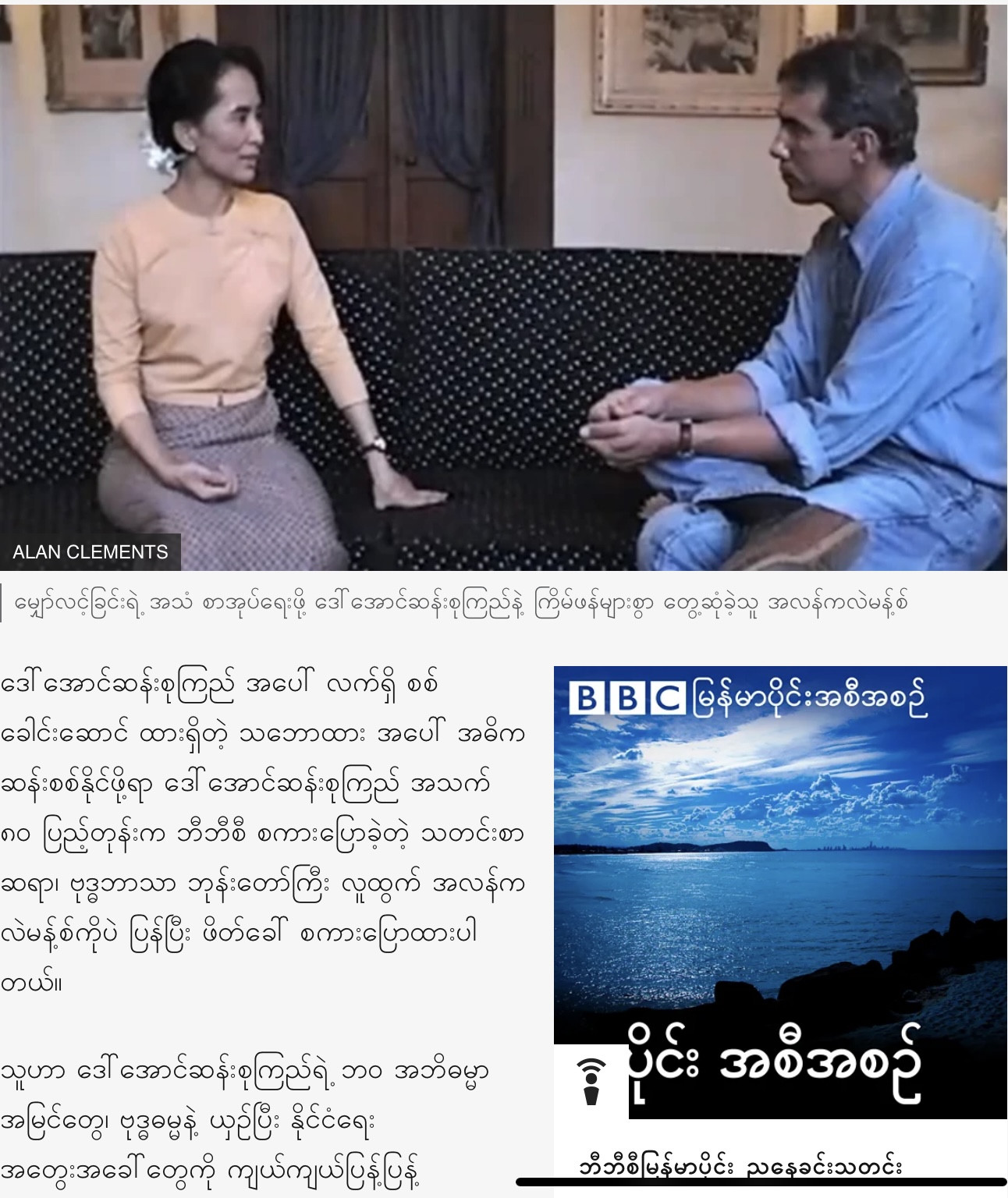
To explore the military leadership’s stance toward Daw Aung San Suu Kyi, the BBC invited Alan Clements, a journalist, author, and former Buddhist monk, to share his insights. Clements, who spoke with the BBC on the occasion of Aung San Suu Kyi’s 80th birthday, is the author of The Voice of Hope, a book detailing her life, her Buddhist philosophy, and the political ideals she developed. He has spent extensive time in Myanmar, analyzing its political landscape during the Thein Sein government’s “Open Door” era and the NLD’s tenure. His latest work, a fictional dialogue with the current military leader, adopts a philosophical and spiritual perspective rather than a purely political one.
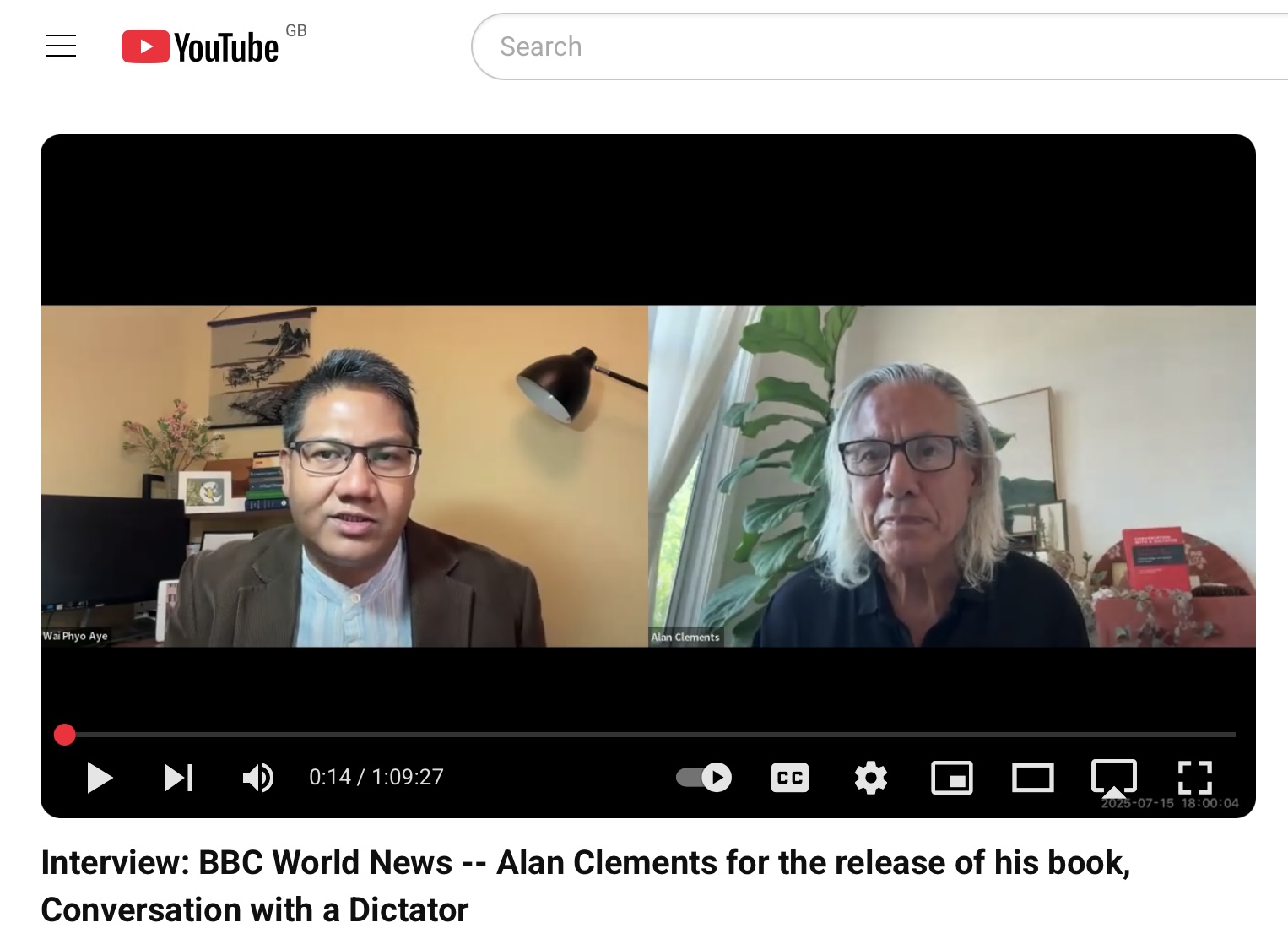
BBC reporter Ko Wai Phyo spoke with Clements to delve deeper.
BBC: What insights did Daw Aung San Suu Kyi share about the military leader and his political ambitions? How did she perceive the military’s broader stance? Observers have long warned that Myanmar’s democratic transition was fragile. Did Daw Aung San Suu Kyi and the NLD fail to fully grasp the military’s true nature?
Alan Clements: From my decades of engagement with Daw Aung San Suu Kyi and her colleagues, I can affirm their profound understanding of the military’s character. I don’t claim unique insight, but their awareness is undeniable. The military has acted with ruthless disregard for human life and social norms, a pattern well-documented and evidenced across history.
Daw Aung San Suu Kyi and her allies have endured the military’s abuses firsthand. No one understands the mindset, ideologies, and personalities of leaders like U Ne Win, U Than Shwe, U Thein Sein, and now the current military leader better than she does. The challenges Myanmar faces today stem not from any lack of insight on her part or that of the NLD, but from deeper systemic issues. Some may recognize this truth but remain silent, as it is an unpopular perspective.
It would be a grave error to view Daw Aung San Suu Kyi as politically naive. She possesses extraordinary intelligence, piercing through deception with clarity, while remaining steadfast in her commitment to non-violence. This approach harnesses the power of dialogue, compromise, and peaceful solutions—a rarity in global politics. Unlike many world leaders who resort to force to suppress opposition, Daw Aung San Suu Kyi and the NLD chose to engage with the military, sitting alongside them in parliament despite personal grievances.
I was in Yangon when U Ko Ni, a lawyer advocating for constitutional reform, was assassinated at the airport by his own countrymen. Such events underscore the military’s nature—how could Daw Aung San Suu Kyi not understand the forces she confronts?
Hanthawaddy U Win Tin, a staunch critic of the military, believed it was irredeemable, a view that diverged from Daw Aung San Suu Kyi’s pursuit of national reconciliation. Her approach required immense moral courage—the courage to lay down arms and seek peace. Few global leaders have matched this resolve. While some, like former U.S. President Trump, have spoken against war, their actions—such as escalating military support in conflicts like Ukraine or Israel—often contradict their rhetoric.
BBC: You recently completed a year-long project, a fictional dialogue with the current military leader. What are its key themes?
Alan Clements: Two years ago, my colleague Fergus Harlow and I co-authored The Voice of Hope: Aung San Suu Kyi from Prison - and A Letter to a Dictator. In it, I directly addressed Senior General Min Aung Hlaing, inviting him to explain to the world why he has plunged Myanmar into chaos—marked by war, bombings, village burnings, and the displacement of over 500,000 people. I sought rational justifications for his actions but received no response. Thus, I crafted this work as an imagined conversation.
This project is deeply rooted in the teachings of my second abbot, U Pandita, successor to Upazala Mahasi and a mentor to Daw Aung San Suu Kyi. He taught that the mindset of adversaries is always open to change, urging us never to dismiss the potential for transformation. The Buddha emphasized awakening a fear of wrongdoing in those who err, a principle shared across religions—Christianity, Islam, and Buddhism alike. This dialogue seeks to explore whether such a transformation is possible in the military leader.
BBC: The military justifies its 2021 coup by alleging widespread voter fraud in the 2020 election, claiming the NLD failed to address it. Beyond this rationale, what do you expect from the military leadership? What must the leader confront within himself?
Alan Clements: I intend no insult, but the military leader’s actions resemble those of an irrational child, driven by fear—fear of prosecution, of losing wealth and status, of becoming insignificant. This insecurity fuels irrational behavior and deep-seated jealousy, particularly toward Daw Aung San Suu Kyi, revered as “Ame” (Mother) across Myanmar and the daughter of independence hero General Aung San.
In contrast to her vibrant spirit, the military leader appears cold and lifeless, waging an unnecessary war to escape his fears. My book aims to hold a mirror to his actions, urging him to recognize their consequences. True greatness cannot be achieved through medals or uniforms but through accountability and moral courage.
BBC: Do you genuinely believe that even those who commit heinous acts can experience a spiritual awakening?
Alan Clements: Absolutely. My belief stems from personal experience. As a young man, I committed wrongs—lying, cheating, even petty theft, like stealing turtles from a supermarket. Yet, through mindfulness and presence, I shed greed, anger, and delusion. I never caused harm intentionally, but I know transformation is possible.
Consider U Tin Oo, whom I deeply respect and who introduced me to Daw Aung San Suu Kyi. Once a commander-in-chief under U Ne Win, he was imprisoned for six years. After his release, he embraced monastic life and the Dhamma, meditating and reflecting deeply. His transformation—from a military leader to a compassionate figure with nine bullet wounds from close combat—mirrors the journey of Emperor Ashoka. U Tin Oo’s freedom from anger and vengeance is proof that change is possible.
This book is not only about the military leader’s potential redemption but also about educating global leaders on Myanmar’s crisis through text and vivid illustrations, urging them to act.
BBC: Can you elaborate on your call to action? You mentioned sending books to world leaders. Are you asking them to take specific steps for Myanmar?
Alan Clements: My colleague Fergus Harlow, a scholar specializing in Myanmar and the Rohingya crisis, and I have carefully selected recipients for our book, packaged in cardboard boxes for distribution. These include leaders of human rights organizations like Amnesty International, Human Rights Watch, and Fortify Rights, as well as political figures such as the UK Prime Minister, the US President, and US Director of National Intelligence Tulsi Gabbard. We are also sending copies to influential figures like Elon Musk, Julian Assange, and Yoko Ono, accompanied by handwritten letters quoting Daw Aung San Suu Kyi: “Please use your liberty to promote ours.”
We call for unity in demanding the release of Daw Aung San Suu Kyi and all political prisoners, ensuring equal opportunities for Myanmar’s 50 million people, including the Rohingya, Kachin, and Shan. Misconceptions about Daw Aung San Suu Kyi’s stance on the Rohingya issue are unfounded; she never defended the military’s actions but insisted any crimes be prosecuted in Myanmar’s courts. Our book, enriched with powerful imagery akin to the Live Aid concert of 1985, seeks to amplify her voice and Myanmar’s plight on the global stage.